Temple stay at sacred Koyasan mountain, Wakayama
- saracooperamun
- Jun 28, 2024
- 5 min read
There are many experiences you can do in Japan, such as trying out a kimono, singing your heart out in a karaoke, eating all-you-can-eat sushi. But have you ever thought about staying at a temple with monks? I had not, at least not initially. But seeing so many shrines and temples all around Japan, it made me curious about learning more about Shinto religion and what it is like to live in a temple.
Koyasan is a mountain temple complex located in Wakayama Prefecture, about 2.5 hours from Kyoto and Osaka. It is considered one of the holiest sites in Japan and the center of Shingon Buddhism. There are about 52 temple lodgings (shokubo) to immerse yourself in monastic life. You can eat what they eat, participate in evening and morning mediations, and other rituals.
I finally managed to visit Koyasan during my last month in Japan, second week of May, with two other friends who were visiting.
Transport
We reached Koyasan from Osaka. From Tokyo it is quite long, as you in any case need to transfer at Shin-Osaka station, and then takes between 2.5-3 hours to reach Koyasan itself.
From Namba Station in Osaka, take the Nankai Koya Line train to Gokurakubashi Station. This takes around 1.5 hours.
From Gokurakubashi, transfer to the Koyasan Cable Car for the 5-minute ride up the mountain to Koyasan.
I recommend booking the Koyasan World Heritage Pass, as it allows for unlimited rides on these transports, as well as buses within Koyasan area. It costs 4090 yen with the limited express option, and 3540 yen without it. The express is only for one-way though and only 20 minutes longer, so if you are not in a hurry, it may not compensate that much, it really depends on the timetable. You can get it online or at the ticket office of Namba station, for instance.
Day 1: Okuno-in cementerey and temple stay
After reaching Koyasan by around 12.30 PM, we first took the bus to our temple stay in order to leave the backpacks. I recommend coming as light as possible, as taking luggage through the temple and tatami mats is difficult. Besides, with a backpack, you can also still walk around without relying on storing it.
Our temple was Komyo-in. It was a cheaper temple, costing us about 25000 yen per person, with dinner and breakfast included. We had read Eko-in was quite popular, but prizes raised quite significantly.
Even if check-in was not due before 3 PM, they let us in by 1 PM, even serving us matcha tea with wagashi.

We had to leave our shoes outside the temple, and were served in a private tatami room, where we would have all our meals. The monk who greeted us seemed nice but knew little English. We were then escorted to our rooms. The temple had a Zen rock garden around it, and several rooms for mediation or sutra writing.

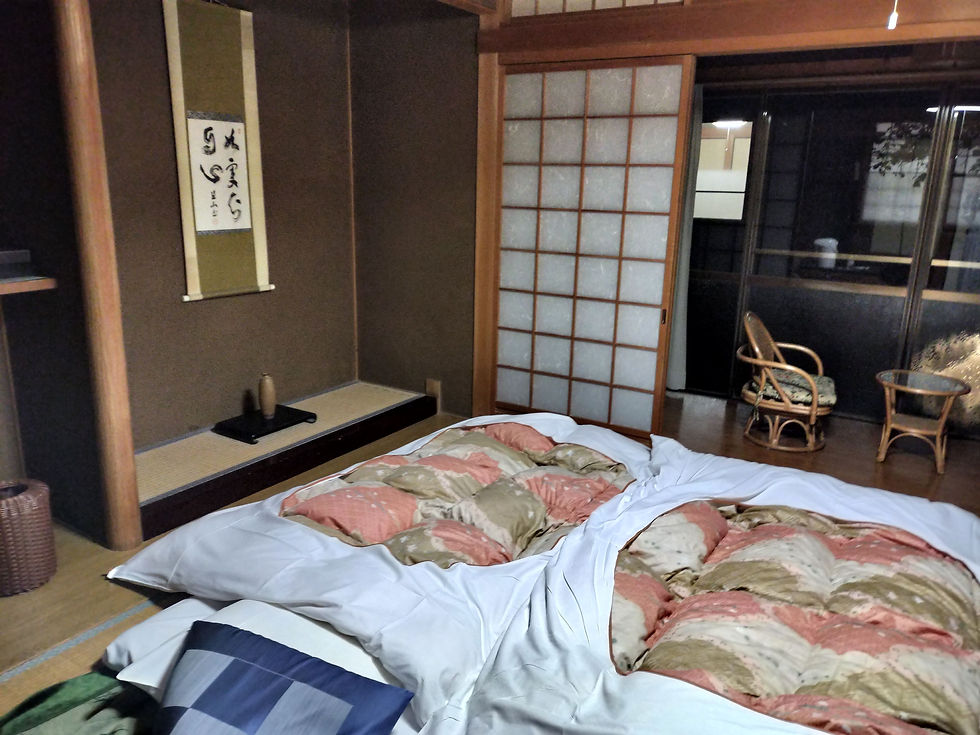
The room was a ryokan-style room, with futons, and a resting area. But of course instead of a normal ryokan, in a temple you had all the extra experiences. We were told we could copy sutra that were in the room in any place we felt relaxed, and given a schedule of the activities.
As we were hungry, we first had some lunch at Kasu Udon, one of the best I have ever tried, and walked to Okuno-in cementery that was only 15 minutes from our temple.

Okuno-in in Koyasan is one of the most sacred places in Japan, with a 2-km long forest that has over 200.000 tombstones and memorials. What we liked the most was sidetracking to the inner part of the forest to appreciate tall cedar trees and hidden tombstones.


At the end of the road you find the Kobo Daishi mausoleum, the founder of Shingon Buddhism, who is supposed to be in eternal meditation. No photos are allowed in this section, and before entering the holy ground, you are supposed to pour water over the statues in front.
We returned to our temple by 6 PM, in order to have dinner. It was purely vegetarian as per the religion, with different combinations of tofu and vegetables.


At 7:30 PM, it was time for the evening mediation. All the temple guests were guided to the main hall (Hondo) of the temple, where a monk showed us how to mediate - sitting down with crossed legs and fingers touching each other. We meditated for about 30 minutes. I was kinda disappointed as I expected the monks to meditate with us, even to eat with us, but I guess in this temple we were seen as observants, they were not there precisely to entertain us.
I could not help but sneak out after the meditation to see the cementery at night. There are some tours also, but I prefered to go alone, while my friends stayed for the bath. I had to be back by 9 PM though as the temple closed the doors.

Day 2: Women pilgrimage walk and temple-hopping

Breakfast was at 7.30 AM, a bit later than other temples, so for that, we were thankful - some may even do the first meditation at 5.30 AM! It was also vegetarian. I usually have difficulties eating Japanese-style breakfast, mainly for the fish or chicken, so vegetarian was actually easier to digest for me. Before breakfast we did a short 30-min meditation, similar to the previous evening.
After breakfast it was time for the Goma or Fire Ritual. It involves making offerings of wooden sticks inscribed with prayers or mantras into a sacred fire. All the guests returned to main hall, but this time sitting at chairs around the monk that was chanting sutras. It was bewitching and quite bizarre, probably the most curious experience of them all.
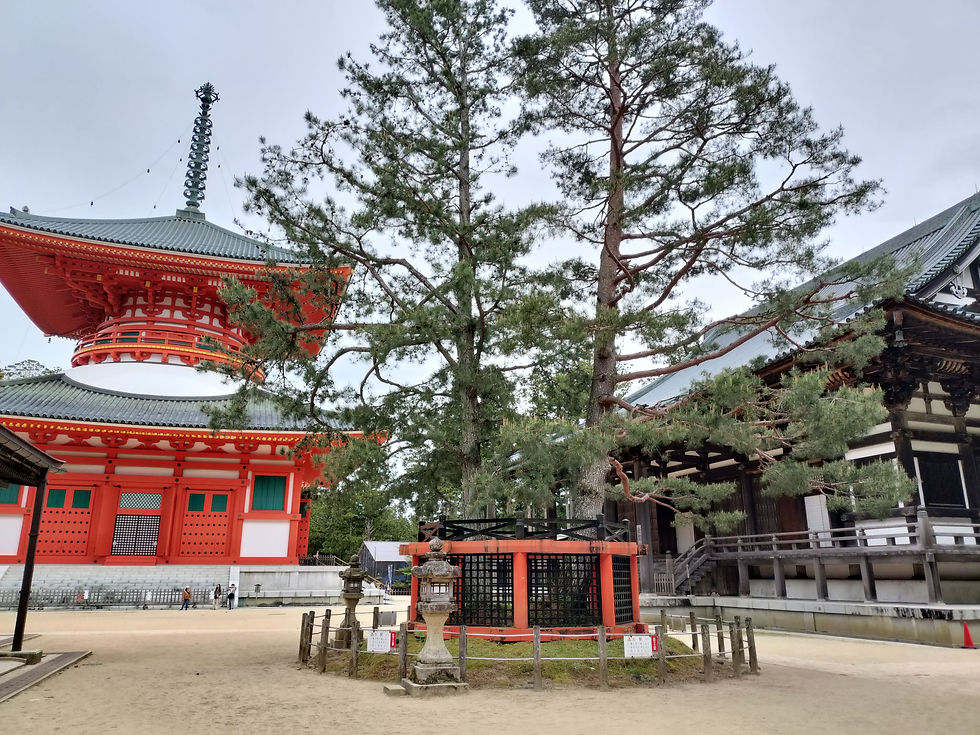
It was time to check-out at 9.30 AM, and explore the rest of Koyasan. While there are many temples, I visited the main ones: Kongobu-ji, with the biggest Zen rock garden in Japan, and the Garan temple complex.

Most temples offer activities like sutra copying. I actually joined an activitiy involving Buddishm initiation, where I was taken to a very dark room. The main monk would say phrases, and I had to repeat them - note, without a paper, so I have no idea what I was saying. Probably things like that I would be good, would not kill, would respect the religion, and so on. Supposedly I was a buddhist after that, until I had my chicken for lunch that destroyed the process.
In the afternoon I went to Nyonin-do temple, where the Women Pilgrimage trail starts. Until 1872, women were banned from entering the holy grounds of Koyasan, so they would walk the circumferencial route around the perimeter. It took me about 1.5 hours, going inside the forest up the hill, accross different torii gates, to finish at Daimon Gate, the entry gate to Koyasan. I hardly saw anybody on the way, made me wonder if there were any bears, but thankfully not.

Around 4.30 PM, I started my way back to Tokyo. It was very tiring, and in retrospective, I should have spent that night in Osaka. I arrived back home by 10.30 PM. It was still a very relaxing experience, without taking into account the transport!


Comments