Discovering remote islands of Japan: Ishigaki, Taketomi, Iriomote
- saracooperamun
- Mar 19, 2024
- 10 min read
Updated: Apr 11, 2024
When I would tell people I was going to Okinawa in November, they thought it would be too cold, let alone to swim or snorkelling. Well, as it turns out, November is a great time to pretty much go anywhere. This was the second travel to Okinawa, see this post for part I of Okinawa -Naha and Kerama islands.
Ishigaki, Iriomote and Taketomi are at the southermost edge of Japan, closer to Taiwan in fact, and part of Yaeyama islands. Our trip consisted of 4 full-days and 2 half-days including flying from and to Tokyo Narita.
Day 1: Arriving to Ishigaki, Monkey village and Fusaki beach
It was a 3 hour flight from Tokyo Narita, flying with Peach Airlines (quick note that hand luggage is 7 kg, including small luggage and any accesories!).
I stayed at 2 different hostels during the stay as one of the friends had to leave earlier: the BREAKFAST HOTEL PORTO Ishigakijima, and Happy Holiday, both in Ishigaki city center. The location is ideal especially if you wish to explore nearby islands as it is next to the ferry port, and local buses also begin in the city.
From the airport it is a 40 minute ride to the city, you can get a 1 day (1000 yen) or 5 day (2000 yen) pass. You can buy it directly from the driver. Alternatively if you are able to get a rental car it is highly recommended as buses are infrequent and not reachable to some areas of the island. For us as we did not have the international license we opted for the buses, and I still think we managed to have a full itinerary.
First thing we did was to have some Yayeyama soba (below), traditional noodles of the island.

Then it was time to start exploring the island!
After taking Bus nª 2 from the Bus Terminal, in about 25 minute we arrived to Ishigaki Yaima Village. It is a cultural village on Yayeama culture, including traditional houses, music as well as an interesting squirrel monkey park. They looked so small and cute, and loved climbing around the trees - you can get some food for them from a machine and for sure they will climb on you as well! All valuables must be left at the entrance box so monkeys are not tempted to take them from you. Walking around the village we also found some mangrove.


At the exit of the village we found two creatures guarding the entrance with the shape of a lion: Shisa. From then on we encountered them almost everywhere, of different colors and sizes. Shisa are a traditional Ryukyuan cultural artifact and decoration derived from Chinese guardian lions, often seen in similar pairs, resembling a cross between a lion and a dog, from Okinawan mythology. Shisa are wards, believed to protect from some evils. People place pairs of shisa on their rooftops or flanking the gates to their houses, with the left shisa traditionally having a closed mouth, the right one an open mouth. The open mouth shisa traditionally wards off evil spirits, and the closed mouth shisa keeps good spirits in.

Back to the bus, next stop was Fusaki beach, on the western side of Ishigaki island. It is especially popular at sunset, and it is of no surprise. We walked along the beach and the resort before taking the bus back to city center.


Day 2: Kabira Bay
Kabira Bay is the main and most well-known attraction of Ishigaki, due to its turquoise and crystalline waters. Black pearls are cultivated there, and for this reason it is forbidden to bath, but there are boats that take you on a tour around the bay for 30 minutes, with a glass-bottom to appreciate different marine creatures such as turtoises, clown fish, or coral.
I took the bus again from the Bus Terminal in the city center (bus nª 2 or nª8) and took about 45 minutes. There are several shops to get Yaeyama doughnuts, ice cream, fresh juice, even hamburgers, next to boat cruise ticket offices.
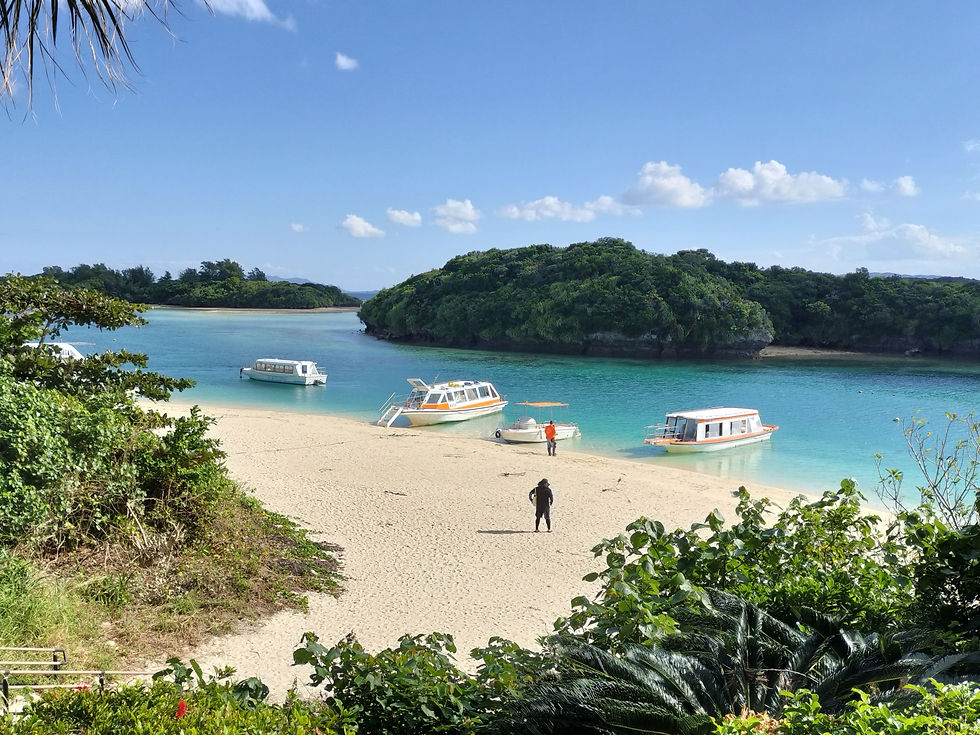

Our tour was amazing, we managed to see many creatures! We then walked along the shore to find the Ryukyu pearl office to see how pearls are cultivated and extracted and some ready-made pearl jewelry.
After spending about 2 hours, we picked bus nª 2 again to continue along the northern coast, in about 10 minutes to arrive at Yoneki Yaki Kobo Shisa farm. It is a free open-air exhibition of different Shisa, varying in sizes and colours.

We couldn't help but by a pair at the shop of the farm!
We had brought some konbini supermarket food, so after walking 10 minutes to Yonehara beach, it was time to sit down and enjoy the picnic. This beach is popular for snorkelling as many coral are gathered there without having to go far from the shore - I did see some starfish too!

Bus nº 11 took us back to the city center in about 35 minutes. Careful not to take nº 2 this time as it goes on the eastern side and can take up to 2 hours to the city!
Day 3: Taketomi island (day-trip)
Okinawa is comprised of roughly 160 islands, can you believe it? For sure we cannot see them all, but it is a good opportunity to visit those nearby.
Taketomi is an island 7 kilometres west from Ishigaki, part of the Iriomote-Ishigaki National Park, and surrounded by hundreds of species of coral. There are only a few accomodations on the islands so most people do a day-trip from Ishigaki.
From Ishigaki Port it took us only 10 minutes by ferry to arrive to the small island, there being a ferry every hour (1500 yen return). Whie it is a small island with only 9 km in diameter, most people rent a bicycle, and so did we - costing us 2000 yen each for a whole day. There are hardly any slopes so it is easy for anyone to cycle around, and there are many rental stores just next to the port - there are even shuttle buses that take you to the stores.
The island is mainly known for its Ryukyu village, with houses equipped with limestone walls and red-tiled roofs that we cycled around.
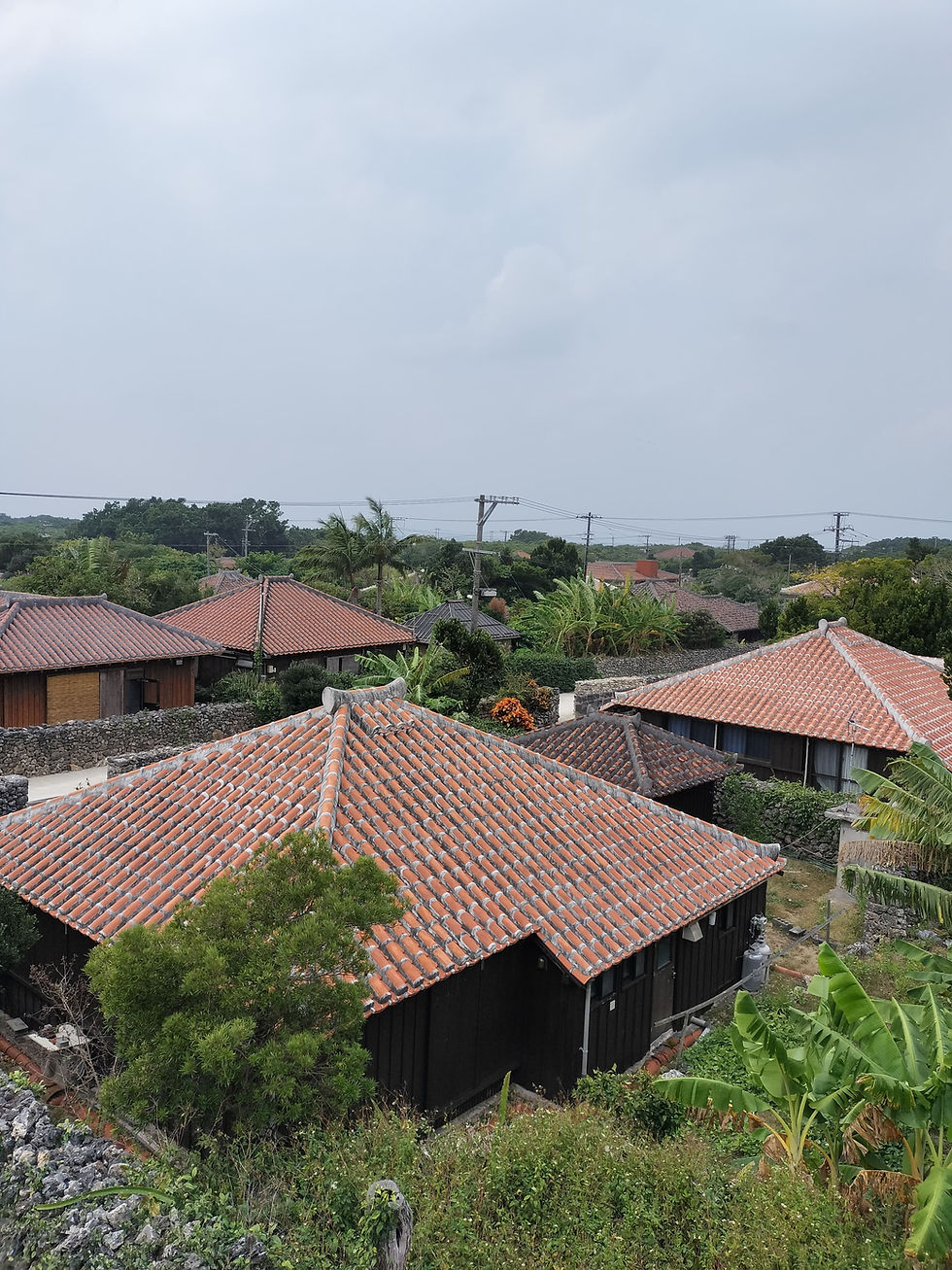

You can several water buffalos walking around the village and carrying passengers as well - I am not too fond of it so we did not do it.

Being an island of course we also visited its many beaches, although as weather turned grey and colder we did not swim. Kondoi beach on the west and Kaiji beach with star-shaped sand are the most popular. We cycled around the whole perimeter of the island stopping at each.


We stopped for lunch at Chirorinmura, I had a typical tofu and vegetable mixture.

By 5 PM we chose to go back to the ferry after leaving the bikes as it was getting colder. For dinner I managed to each some umido, sea grapes - a traditional Okinawan dish that has a lot of umami flavour.

Day 4: caves, mountains and beaches
Originally we wanted to go snorkelling, either back to Yonehara beach or Phantom Island, but as it was due to rain, all the tours we had contacted told us they were cancelling - probably due to high waves rather than the rain. So we adapted our itinerary to start with exploring the inland first.
As mentioned, buses are infrequent, so we carefully checked the timetable to arrange the day, starting from Ishigaki Bus Terminal.
First we stopped at Ishigaki Stalagtite Cave, the perfect escape from the rain (1200 yen entry). We were not too impressed, but maybe because we have been to quite a few caves back in Spain, and we were out in less than 40 minutes.


From there we walked to Mt Banna park in about 30 minutes, instead of waiting for the next bus. It was a much bigger park than we expected. We chose to walk the hard way by climbing up to Mt Banna, which was quite steep and took us 1.15 hour, and reach the Emerald Sea Observatory Deck. There is also a bird-watching observatory nearby, and the views from both are very nice - it has a shape of an egg so easy to spot!


Walking down to the other side of the park we crossed Seishika Bridge. The whole way we were surprised as not only the park had such tall peaks but the roads was surrounded by tall trees that appeared to be from a real jungle. We also saw many butterflies following us on the way - and very little tourists.


From the bridge we returned back to the starting point to catch the bus (another hour walk) of 15.30 PM. In total we had spent about 3 hours in the park. We wanted to go back to Kabira Bay, and then visit another nearby beach - Tabaga beach. It is a bit difficult to find the way to enter, seems also like entering a jungle for about 20 minutes before emerging to the sea shore. It is quite rocky with many interesting shells, but the sea was quite rough. The deep and clear blue though were fascinating.

We walked back to Kabira Bay area (another 35 min), and had dinner at Sushi Jinbei, finding it by chance, just next to the bus stop. It was cheap for the Kaisen don set (raw seafood bowl), repeating the sea grapes again as well.

Day 5: Iriomote adventure
Iriomote is the largest of Yaeyama islands, and is known for its extensive jungle. It does not have any airport so the only way to arrive is by ferry. The Iriomote cat lives there.
Being there, it looks nothing like Japan but a tropical jungle from Tarzan.
We took an early ferry from 7 AM, taking an hour to reach the port. Note there are 2 ports, and the closest one is often shut down due to high waves, so we also were dropped on the second one.
We had booked a tour for kayaking and hiking around Pinaisara falls, a waterfall in the jungle. The guide picked us up from the port, and after another 45 minutes, we got onto our kayaks.
The path was so relaxing, the water was hardly moving, and we were surrounded by mangrove.


After 40 minutes, we parked our kayaks and started hiking. I was not expecting it to be that much trekking, we had to use our hands in some parts to climb up, or go through narrow edges. It was really a jungle and we were thankful it was not summer, as at least mosquitos were not many, even though it was hot for November.
For reference, I would checkk beforehand difficulty level.
It was so worth it though, to reach the top of Painaisara Falls, the highest peak of the island. My friend and I could lie face down as we approached the edge of the waterfall to look down, it was truly breathtaking!

At first we were alone (we were that fast?) but soon some other tour guides came along. All the guides were preparing a meal for the guests. For us it was noodles, the guiande was carrying a mini stove and all the food all the way up. It was the first time having fresh noodles on the top of a waterfall. Others were having hot chocolate, curry or soup.

Heading back was equally challenging, to the bottom of the waterfall. Other Japanese may have thought us crazy, but we couldn't help but dip in the water, cold as it was. Afterwards the guide gave us another snack, a mochi with strawberry flavour.

Then it was time to head back to the kayaks, but we took our time on the way. It was about 3.30 PM by that time. As we waited for the shuttle bus to take us back to the port, we had a short time for coffee. It had been a long and adventurous day.
For those planning to go to Iriomote, renting a car could be useful as well, but definintely also get a kayak tour, as it is the only way to really access the inner parts of the island!
As it was our last night we treated ourselves to some Ishigaki beef steak and Orion beer, Okinawan specialty. The restaurant was in the city center: Meat Bar Butcher Trico.


Day 6: around Ishigaki
It was our last day. My friend had to work, and as we had seen most of the sights already, I chose to take a 1-day buss pass as the 5-day one had expired the previous day, to travel around the east side of the island. Again, everything was pre-planned to make sure there were buses to different points.
First, taking the Ishigaki-Airport Limusine bus, I went to Shiraho beach (25 min). I indulged myself in some breakfast at Shirahoie cafe (しらほいえカフェ), that has a nice garden view. It is very popular for breakfast and has a fixed set menu of 2000 yen. In the picture you can see I had local fish, soft omelette (fua-fua in Japanese), soup, rice, pickles, and for dessert a brownie and panna cotta.


I did not stay much on the beach itself as I had to take the next bus, but again there was hardly anyone at the beach which surprised me.
It was 30 min ride on bus nº 3 to the next stop, driving next to the eastern shore: Tamatorizaki Observatory Platform. The bus stops just below and is a short way up. The view was nice although nothing spectacular.

As I had to wait 3 hours for the next bus, I walked north from the observatory. It was refreshing but at the same time odd not seeing anyone else, except for cows, and vending machines integrated within the jungle-ish path. It really is amazing how they pop up wherever you go in Japan.
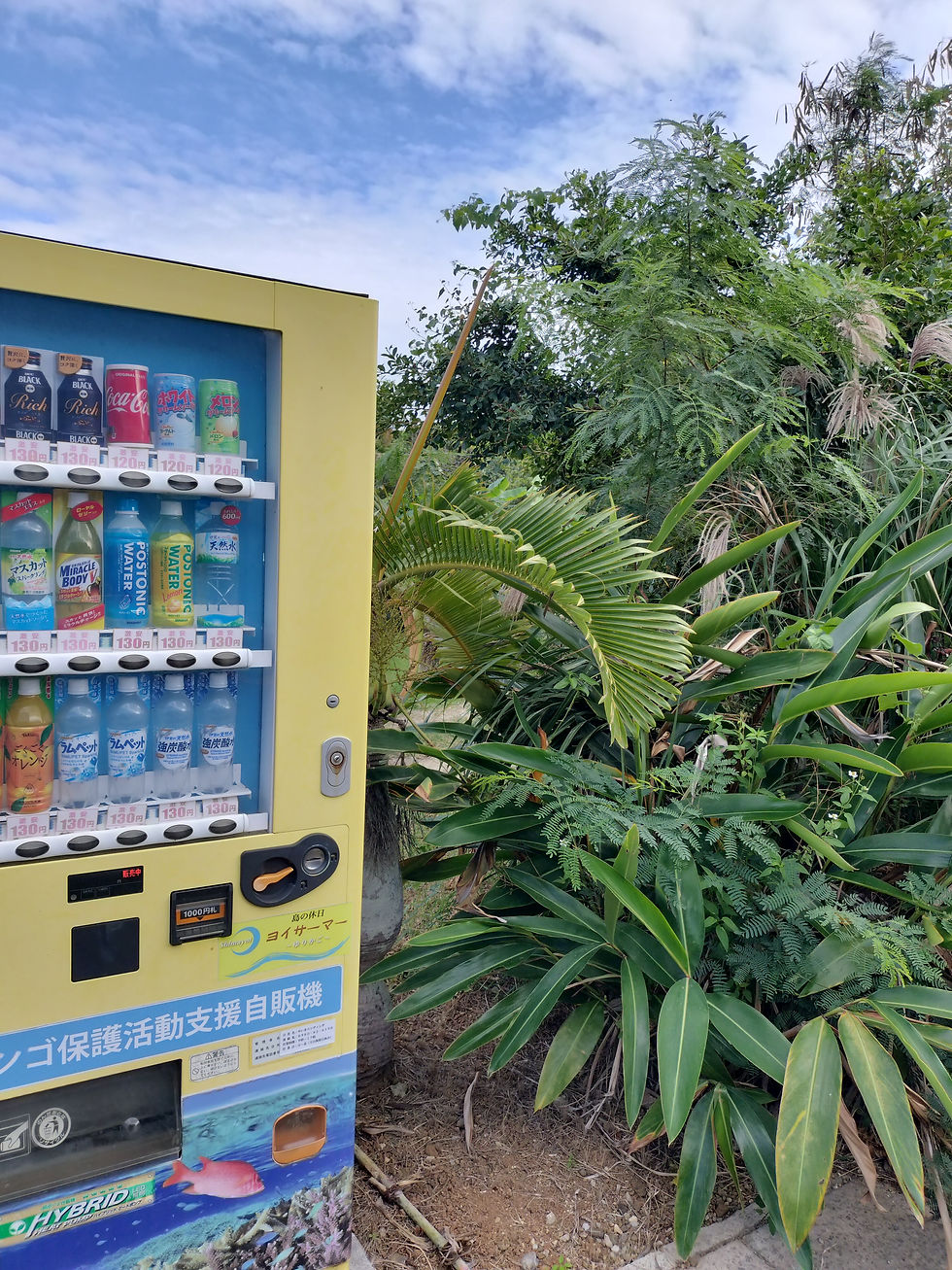
In about 40 minutes I turned right to find a beach - not directly indicated by Google Maps. There was a funny looking rock, the Ibaruma Hard Rock, and a few seats along the beach. Taking opportunity of the lack of fellow tourists I spent some time reading and having a swim. Before taking the bus I found a hidden cafe serving rich smoothies with smiley faces, called Smoothie &bowl Neo-earth cafe-Roots- Ishigaki. I practiced my Japanese with the nice woman before boarding the bus.


It was another 30 minutes to reach the airport, and we flew back to Tokyo Narita. The week in paradise was over, but I can say that it was a nice discovery and that November is, in fact, a good time to go, specially as it doesn't seem to be too touristic yet. The only thing pending for us was snorkelling or scuba diving.


Comments