Out-of-the-beaten path Japan: Shikoku
- saracooperamun
- Apr 1, 2024
- 16 min read
Updated: Apr 11, 2024
Shikoku is the smallest of Japan's four main islands, located southwest of Honshu. It is divided into four prefectures. It is known for its nature, the 88 Temple Shikoku Pilgrimage route, and udon.
I had wanted to go for awhile, to get away from the crowds and explore this lesser known area, but as it requires at least one week to nicely cover it, I had been waiting for a good time. This would also be my first time solo travelling in Japan for a longer period of time.
From Tokyo, flying would be the most convenient option to either Takamatsu or Tokushima, as it is cheaper than taking the trains - also requiring changing several times. But I wanted to travel on a budget, I chose to take overnight buses, and start the travel from Nagoya, where I had been spending the weekend. A consideration to take is the use of the All Shikoku JR Pass . The cost are as follows (if purchased overseas is 500 yen less):
3 days: 12500 yen
5 days: 17500 yen
7 days: 20500 yen
I recommend first planning the itinerary and then estimating if the pass is worth it. For me, it was not, actually I spent a total of 9000 yen roughly on the trips that the pass would have covered for me during 1 week, so I would have wasted 10000 yen. The main reason is that Shikoku has no shinkansen, so they are all local or rapid trains, and to visit many areas you need buses that are not covered by the pass.
Day 1: Matsuyama and Dogo Onsen (1 night)
I arrived on the overnight bus from Nagoya at 7 AM to Dogo Onsen, one of the oldest hot spring resorts in Japan. I was spending the night at Fujiya guest house, very convenient as it was just 5 minutes walk from where the bus dropped me, and everything was at 15 min walking distance. I could have stayed at Matsuyama city, but I think staying at the onsen area was more charming and also were most of the attractions of the city are located. The guest house had a living room with a kotatsu, and I could use a shower as well as drop my bags even if I could not check in, which was nice.
Botchan Karakuri Clock is the first place I visited, an old clock that shows moving puppets, characters of the novel Botchan, to the music.

From there to Dogo Park to have a konbini takeaway coffee and admire the city view from the top, it also have a nice Japanese garden on the lower side.

As it was just about 9 AM, I decided to walk to Matsuyama city center and visit Matsuyama Castle. There are also old-fashioned trams running between Dogo Onsen and the city.
I was a bit sceptical about the castle as I had already seen many in Japan. But with 1040 yen, you can take a cable car or chairlift and access the castle itself. If you are not afraid of heights or not being too secured, I recommend the chairlift. At this time of the year there were already cherry blossoms on the way as well.


The castle itself is quite big, and considered one of the oldest being from 17th century. Note it has very steep and wide stairs so may be difficult for some people to walk inside the castle. Afterwards I had a freshly squeezed mikan juice (mandarin-like) on the shop in front of the castle entrance, one of the specialties of the region.
After some udon for lunch, I walked back to Dogo Onsen by 1 PM, and visited Isaniwa Shrine and Hogonzi Temple, but was not particularly impressed. It was then finally time to try some onsen!

The main onsen in Dogo Onsen Honkan, a 300-year old onsen that is also visited by Japanese monarchy. But it is now under construction and you can only have a bath, as the resting area is closed.

So I chose to first visit Dogo Onsen Annex Asuka-no-Yu, a newer version. With 1250 yen, you can both use the onsen and the resting area, and get some tea and a sweet. I was a bit disappointed as the onsen had only one indoor and one outdoor - that was not really outdoor just having some gaps on the ceilings to let air in. But the tea experience somehow compensated it as they also provide a yukata to walk around. I definitely think it is not worth it entering to only visit the onsen.

I thought I could stay as long as I wanted but as it was 90-minutes, I walked about 20 minutes to Ishitenji Temple, one of the 88 Shikoku Pilgrimage temple. It is a spiriual journey accross Shikoku where people wear white clothing, sedge hat and a wooden staff. I could see groups of older Japanese people doing the pilgrimage, but no other tourists asides myself. It even has a pitch-black tunnel, but I was scared to go in as there were also steps.


For dinner I went to Dogo no Machiya known for its hamburgers, and finished by going to the actual Dogo Onsen Honkan as this time I was fine to only take a bath. The entry is 420 yen and there is only one onsen pool. It is expensive for what it is, but you can appreciate the older architecture and different features within the onsen.
I think 1 day is perfect for Matsuyama, and staying in Dogo Onsen was definitely a plus. I would, however, favour other onsens in Japan and visit the city mainly for the castle.
Day 2: Kochi (2 nights)
I went to Dogo Onsen Sky Footbath first thing in the morning, just about 10 minutes from the hostel. It is a small footbah overlooking Dogo Onsen Honkan, but as there was mild rain, it was quite empty.
To go to the next destination, Kochi, I took the tram to the city center, to then catch a bus. With the rail pass, the bus is not included and you would need to take trains, changing once, and taking up to 4 hohurs. The bus, in contrast, is only 2 hours long and costs 4000 or 2500 yen.
Kochi is the capital of Kochi prefacture, mainly known for Kochi Castle. I stayed at Harimayabashi Guesthouse for 2 nights, in the city center. I had some issues entering as I had not been sent a PIN, and had to call - notice that in Shikoku in general most people do not speak in English so is good to know some basic Japanese for situations like this. The stay was good however as you could use its kitchen and the commo area, and there were hardly other people.
I went to have lunch at Hirome market, a popular fish market, and tried the famous katsuo no tataki, a dish made with lightly seared skipjack tuna or bonito (1000 yen for 6 pieces).


In the afternoon, I visited the castle, just 10 minutes from the market. It was much smaller than Matsuyama's, and as it is in the middle of the city (although it does have a park surrounding it), I did not find it too special. It only costs 420 yen however to enter so of course if you are in the city you should still visit.


Tired from the journey I got some takeaway food from the konbini to eat at the hostel. But between the castle and the hostel there were many restaurants and shops and seemed quite lively.
Day 3: Exploring the surroundings of Kochi city
As Kochi is not a touristic place - and well, Shikoku as a whole-, it takes some planning to move around without a car. Most of the nature is outside public transport reach, but for one day, there is a bus pass called My-Yu, that can be purchased at Kochi tourist office near the castle. If you show a foreign passport it only costs 500 yen (else, 1000 yen). The bus allows you unlimited travel around Kochi city and discounts accessing several attractions. I had to be careful and plan well the itinerary as bus times were infrequent nevertheless.
The first stop was the Kochi Prefectural Makino Botanical Garden, 50 minutes by bus (660 yen with discount). It is quite a big garden with different flowers and areas, including an interior garden.

From there I then walked to Chikurinji Temple, one of the 88 Shikoku Pilgrimage temples. There were far less people than the one in Matsuyama, and this one mainly had a pagoda. Godaisan Observatory is just behind the temple with views to the city.

From there those doing the pilgrimage walk south, to Zenjibu temple (another pilgrimage temple). You can also take the My-Yu bus, but then walk 30 minutes. For me I chose to skip it and go to Katsurahama, the south edge of Kochi (30 min by bus).

I quite liked the beach, had my konbini lunch there, and walked around the shore to Kaizumi Shrine, located on the edge of the cliff. The beach also has an aquarium and there are a few other things to do there, but I spent most of the time relaxing on the sand.

I took the bus back to Kochi city center returning from the west side - doing the whole circle (30 min). As the pass also has the Kochi tram included, I took advantage to use it to go back to Hirome Market for some dinner, this time fried crab and prawns.

For those thinking of coming, I do think that having a car is quite essential as without it you cannot access more remote areas of Kochi Prefacture like Muroto or Shimanto river, that I was quite interested in.
Day 4: Oboke Gorge and Iya Valley (1 night)
The hidden gem of Shikoku, probably one of the most unexplored areas of Japan, Iya Valley in Tokushima Prefecture has historically been remote and difficult to access for a long time. It was the main reason why I wanted to come to Shikoku as well due to its vine bridges and nature. At least now there are buses, although scarce, that travel inside the valley. Although again, a car could be handy.
I took my first train in Shikoku from Kochi station at 9 AM, arriving at Oboke Station by 10 AM. Thank god to the lockers, I chose to leave my hand luggage for two days there (1000 yen for both days, as the locker clock is restarted at midnight), it is better to pack light for the buses within the valley.
Before heading into the valley it was worth it to have a walk around Oboke Gorge. From behind the station, following Yoshino River, I arrived in about half an hour.

I took a sightseeing boat, that costs 1500 yen and navigates up and down the gorge for about half an hour. The gorge had spectacular rock formations and crystal clear water.
There were people doing kayaking and rafting, which must have been fun too.

I had to wait a bit for the bus, there was an udon restaurant just where I got the tickets for the boat but I was wary to miss the bus so I chose to wait. At 1 PM it came and it was time to explore Iya Valley!
The buses need to be paid in cash, and is recommended to get change from 1000 notes or coins beforehand within the bus.
It took about 45 minutes to Hotel Kazurabashi stop. I was not staying there but that was a far as the bus could take me. The area already seemed remote, surrounded by mountains, a flowing river, even some cherry blossoms. Following the river I arrived to Kazurabashitei to have some more udon, next to a big parking lot, one of the few places to find food in the area. They also have some information on the vine bridges of the valley.
It was then time to see the famous Kazurabashi vine bridge. It is a pedestrian foot bridge made from wood and ropelike vines. Crossing it costs 500 yen, and wow, the gaps between the vines were big, and the bridge swayed more than expected. I was surprised that many tourists together were encouraged to cross. But it seems their repair the bridge every 3 years, and then again, it is Japan, one of the most safety-obsessed countries.

Around the bridge I also visited the Biwa waterfall and got closer to the river rocks. Mori no Kumasan is a cafe just next to the bridge that seemed to serve nice cakes and coffee, but I didn't try.

I stayed just there in Iya Kankou Ryokan. I recommend it 100%, not only is it 5 minutes from the vine bridge, but also next to a bus stop. I had my own room with a futon, and tea with some biscuits already served.

It does not have an onsen but yes a bath, and the nice old lady gave discounted tickets to the nearby onsen of Hotel Kazurabashi (only 700 yen from the original 1200).
I went to the onsen by 5 PM, and I think it is so far my favorite onsen in Japan. I had to take a cable car to go up to the rotenburo, that overlooked the valley. Not to mention there was no one else - there really were no tourists. It also had a relaxing area, and even the indoor onsen down below had a nice view.

At 7 PM it was time for dinner at the ryokan, a nice combination of sashimi, chicken, tofu and other things. I ate it on the first floor together with other guests - actually seeing foreigners for the first time in awhile.

The old lady recommended we had a look at the vine bridge at night, so we did - it was lit up and looked sinister. I saw many stars as well. But it was very cold, below zero degrees.
Day 5: More onsen and travel to Takamatsu (3 nights)
Breakfast was equally tasty, not as ample as in some other ryokans, but I don't necessarily like having a big breakfast, so it was perfect. After checking out, I chose to walk instead of waiting for the bus that was coming at 10.40. Weather was better and not as cold today, and sunny. It was a walk along the road, but there were hardly cars so I could still appreciate the surroundings.
At some point I hopped on the bus headed to Hotel Iya Onsen, the only hotel of the valley, located north. Before heading in I couldn't help but greet the Statute of the Peeing Boy, a small boy that overlooks the valley. It is similar to the one in Brussels.

The onsen this time cost 1900 yen, quite more than the other one. You also take a cable car, but this time, instead of going up, it goes down to the bottom of the river, to bath next to it. The cable car is manual so it is quite funny because you need to press the buttons internally to start or stop moving.

The indoor onsen was nothing special, but it was nice to after have a konbini coffee overlooking the river. Overall I would say Hotel Kazurabashi one was better prize-quality wise, but if you love onsen like I do, please try both.
Again as I still had 2 hours for the bus, I chose to walk back down, for about 1.15 hours. I passed an observation point where you can see the river bending.

Kind of rushing I managed to pick the bus at some point to go back to Oboke Station. I had a bit of an issue with the trains, as I got on the local by mistake at 3 PM. Originally I planned to stop in Kotohira to visit its famous shrine, on the way to Takamatsu, but due to the mistake I chose to skip it (besides there are many steps up Kotohira and it was already 4 PM). In the end it was around 5.30 PM when I made it to Takamatsu, my last stay. I would spend 3 nights at BJ-Station hostel.
Day 6: Falling in love with art in Naoshima
The hostel was conveniently located as it was next to the train station but also the ferry terminal, perfect to visit the nearby islands of the Sento Inland sea.
Naoshima, Japan's art island, is known for its contemporary art installations, museums and sculptures, all within a small island equipped with beaches and tranquil atmosphere.
The ferry cost me 1040 yen (520 each travel), taking 50 minutes. There is also a faster one costing 1220 but considering it takes 30 minutes, I don't think the cost is compensated. Once on the island, the red pumpkin is the first see you see on the side of the ferry port.

I booked an electric bike, which is recommended to visit the island as while small it still has 7.8 square kilometers. There also some steep areas, although after spending the day, I think the mechanical bike would have been fine too. The electric bike cost me 1500 yen, but there were others cheaper like 1200, if you are fast enough to get them.
There are many beaches around the island, and it was a sunny day, making it suitable to lie down and read for awhile. There are several public art displays that you can see for free, like colorful animal sculptures.


There were, as mentioned, many museums, but I chose to select the 2 main ones.
The first was Chichu Art museum. I had to book the tickets in advance (costing about 2100 yen), as they sell out. Before entering, as I had the time at 12.15 PM, I left the bike and walked further down Benesse House area (no bikes are allowed here as it is a private zone). The other pumpkin, the yellow pumpkin, was right at the edge of the beach. There is also a souvenir shop where I got a pumpkin keychain.

A free shuttle bus took me back to Chichu museum, that works on the private zone.
The museum was interesting. it is modern art in an underground building, with inspiration from Monet. I won't spoil the content, but considering I am not an art person, I was quite content. Even the food was good, having a great vegetable platte - only 1100 yen.

From there I cycled from the middle of the island to the other side, where the Art House Project is locatd. It is a another port village with traditional old Japanese houses. From the tourist office you can get a pass to visit 5 houses (1020 yen), which is very worth it. I left the bike to walk around as it was easier. Again, no spoilers, but they all have something different inside. Ice cream seemed popular as well and there were many cute coffee shops.


When finished I cycled back to the initial port. There was an onsen, called I love u onsen, supposedly also decorated, but didn't go in as I had been in many onsen that week already. The last ferry back to Takamatsu was at 5 PM.
Day 7: Olive park and gorges in Shodoshima
Shodoshima is the second largest island of the Sento Inland sea mainly known for its olive production. If you took the Shikoku raill pass, the ferry and bus are covered (but not for Naoshima or any other ferries or buses).
Unlike yesterday, it was a rainy day, but I managed to somehow adapt the itinerary.
The ferry took another hour, costing 1300 yen for return trip (slow boat). I got the 1-day bus pass from the driver (1000 yen), and taking advantage of still not raining, went to Angel Road first.
Angel Road is a 500 meter long sanbar that connects mainland Shodoshima to other smaller islands. When the tide is low, you can cross and it is said that crossing it with a partner holding hands strengthens the relationship. When I got there the tide was decreasing, but not quite low, so it was funny to see people waiting on the edge for the water to clear.

As I got on the next bus it started raining, which was a bit of a shame. It took about 40 minutes to go arrive to Koun Station, the lower side of Kankakei Gorge. After visiting Oboke Gorge I was really getting obsessed with these natural wonders.

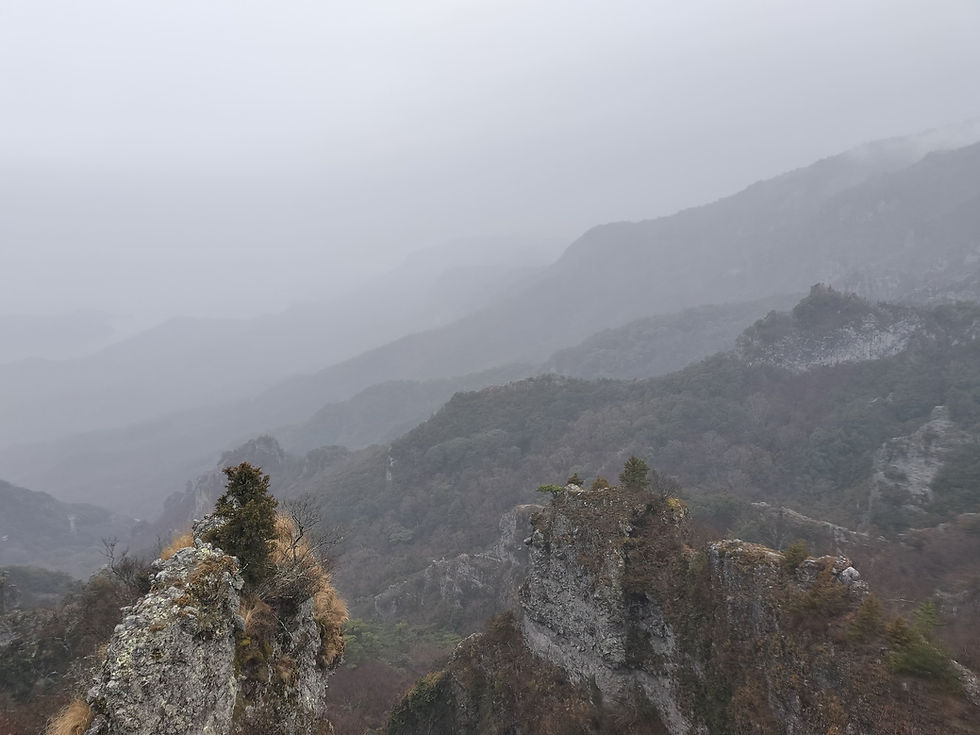
I took the ropeway up (about 2000 yen return). It was so packed with people though that I couldn't see much of outside.
The views from the top were pretty nevertheless, there are also tables to eat and a shop with croquettes. I walked around a bit to visit a shrine and other viewpoints of the gorge. I considered walking down, it would take about an hour and I had seen there were other places to see on the way, but as it was starting to rain more heavily I chose to take the ropeway back - in spite of the rain, I could appreciate the gorge much more as it was less packed.
From there I went to the Olive Park (30 min by bus), the main attraction of the island. I was surprised to learn that the island produces olives due to its mediterranean climate, thanks to that it is the birthplace of olive production in Japan. There were many different types of olives that I could see, thanks to the break in the rain. This was also the setting of Ghibli animation's Kiki the movie, so people were borrowing a broom and taking a photo pretending to be in the air - I also went along with the flow.


When it started raining again I couldn't avoid going to the onsen in the park (San Oribu Onsen). It was more like a spa with Jacuzzi and other more fancy things, but cheap (900 yen with towel rental).
Back to the port for the 5.30 PM ferry and to Takamatsu for the last night.
Day 8: Takamatsu highlights and Kurashiki (Okayama)
It was time for the last day of the trip, and it would be a packed day.
By 9 AM I headed to Yashima mountain, on the east side of the city. It is part of the 88 Shikoku pilgrimage route and this time I wanted to walk a part of it. Best is to get off the train at Kotoden-Yashima station. I had some issues finding the entrance of the trail, find 屋島 登山口 on Google Maps, about 20 minutes walk from the station. There is also a shuttle bus that goes up to the top, but what is the fun in that?
Again I could not see other tourists, only a few older Japanese walking down the mountain. The hike was amazing, quite steep but constant, and could see tiny statues along the way.

It took me about 40 minutes from the start of the trail, although I had read it took an hour.
Yashima Temple is the main highlight, and the grounds are quite big.

There were quite a few animal statues and red toriis.

I walked to Shishi-No-Reigan viewpoint to see the city and the other islands, and there is quite a lot more walking you can do. For me I soon started heading down, passing old ruins of a castle along the way. to be back down by 11.45 AM.

From there I moved to Ritsurin Garden. It is the main attraction of Takamatsu city and considered to be one of the 3 best gardens in Japan. It only cost 420 yen to enter, and I had a tasty tonkatsu and udon set within the garden. I spent about an hour walking around the lakes and the different gardens.

Finally I took the bus back to the hostel to pick up my luggage and to the train. It was time to part from Shikoku! But I had booked an overnight bus from Kurashiki, in Okayama. The train crossed the bridge between Shikoku and mainland to reach Kurashiki in under 1.5 hours.
I had time between 4 to 8 PM, so leaving my luggage in the lockers of the station I went to explore. Kurashiki is considered to be like a Japanese Venice as it has a canal with picturesque houses surrounding it. There are boats you can take, but I was too late and they were sold out.


I visited Shinkeien, a relaxing garden, and then at Yuuri-an coffee shop a happy pudding (literally a pudding with a happy face).


As it grew dark the canal was illuminated as well as some other areas making it magical.

The bus back to Tokyo left at 8 PM from the station, it was a long 11.5 hours journey but as I had the next day to rest, could not complain.
Overall it was a very enjoyable week. It was more laid-back than other trips within Japan, allowing for rest and sightseeing, and definitly less touristic and cheaper.


Comments